I
The Grande Remise trade
The Grande Remise is an ancient trade — that of the carriages of distinction and the men who kept them. Maison Vehira carries on its exigence: a chauffeur here does not drive, he serves.
The Grande Remise chauffeur differs from the driver as the maître d'hôtel differs from the waiter. Driving is only the visible part of his trade. The rest — the punctuality that needs no reminder, the memory of habits, the bearing, the restraint — is what truly makes the quality of a crew.
The House chooses its chauffeurs one by one. It does not recruit on the licence alone, nor on experience alone, but on that rare disposition to hold oneself in the service of another without ever being lost in it.
II
What the House requires
The four virtues of the crew
-
Smooth driving
A motorcar never felt — not in the acceleration, not in the bends
-
Knowledge of the territory
The corniches, the shortcuts, the discreet palace entrances, the hour the road clears
-
A sense of protocol
The codes of service to the elite, learned alongside the palaces and the great houses
-
The right silence
To speak when expected, and to keep silent the rest of the time
III
The training
Before taking the wheel for the House, the chauffeur learns the territory. Not the map — any navigator knows that — but the country itself: the hour the lower corniche clogs, the discreet car park behind the palace, the villa whose drive allows but a single manoeuvre, the quay where one sets down without obstructing the gangways.
He then learns the codes. How to open a door, when to step out and when to remain, where to stand during the wait, how to greet without imposing. These gestures, which cannot be improvised, are passed on in the manner of houses — by example, and by patient correction.
IV
Attire and discretion
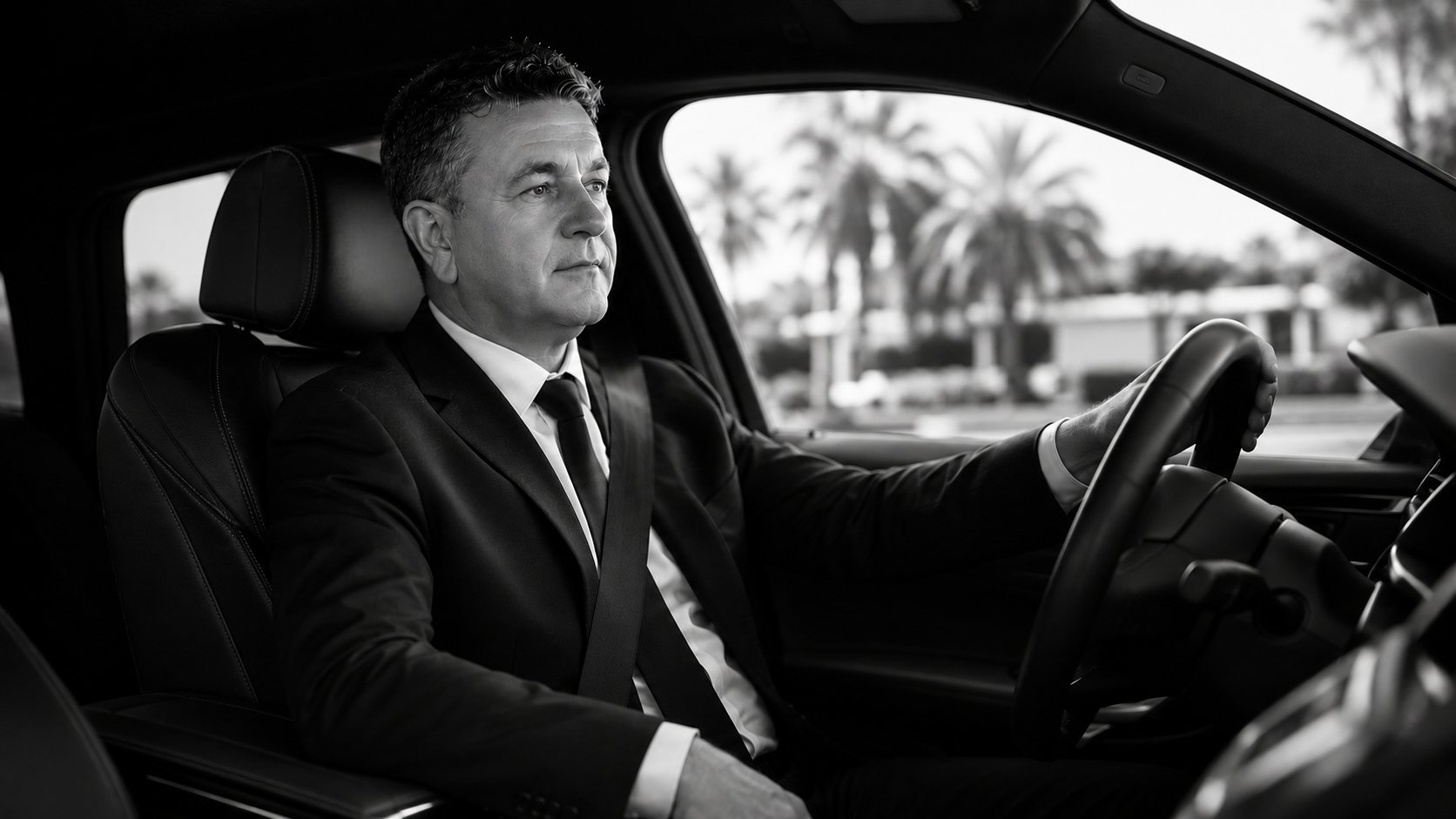
The crew wears a dark suit, sober, without ostentation. The attire is not a uniform: it is a way of disappearing into the décor of palaces and villas, of being in one's place there without ever taking it.
Discretion, finally, is the cardinal virtue of the crew. What the chauffeur sees, he does not report. What he hears, he forgets. The names, the addresses, the presences on board belong only to those who live them. It is on this condition alone that a house earns the trust of the elite.
The good chauffeur is noticed only by his absence of fault.
The crew and the fleet are the two halves of a single care: men kept, motorcars kept.